
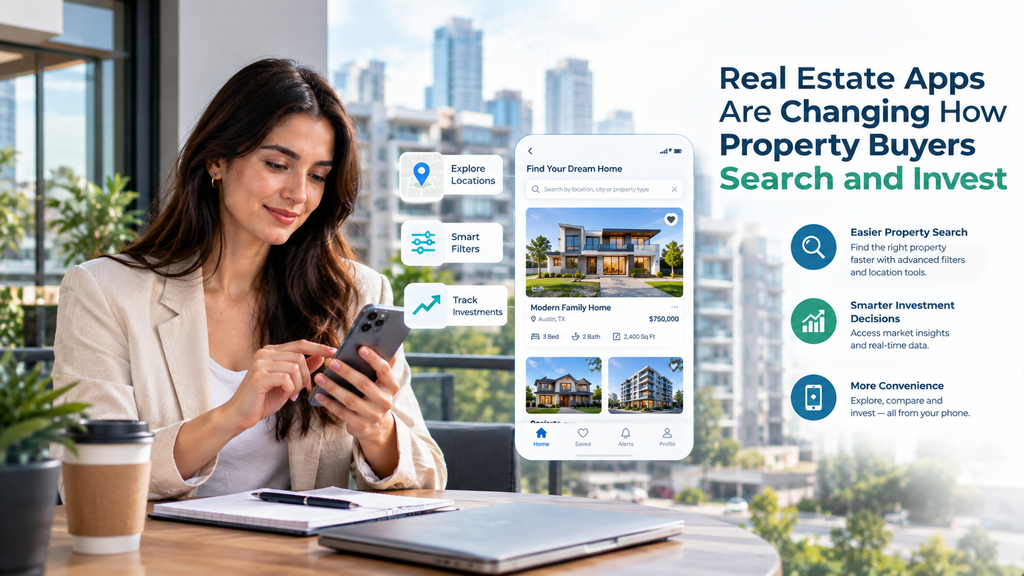
Natasha Petrov had been a property buyer for seven years before she bought her first apartment without setting foot in it before signing the contract. The property was in Dubai, she was in Moscow managing a business that couldn’t spare her for a week-long property trip, and the developer was offering pre-launch pricing that would close before she could arrange a visit. What made the purchase possible wasn’t blind trust. It was a real estate application that gave her a 3D virtual walkthrough of the unit, live availability status across the development, a price comparison tool showing her how this unit’s per-square-foot pricing compared to completed projects in the same corridor, documentation on the developer’s track record with three previous launches, and a direct line to a registered broker who answered her due diligence questions through the application’s secure messaging feature rather than through a sales pitch on a phone call. She had been researching Dubai property for four months through that application before the opportunity arose. By the time the pre-launch window opened, she wasn’t a cold prospect making a rushed decision. She was an informed buyer acting on conviction that had been building across 37 property research sessions, 12 saved listings, and 8 direct broker conversations that the application had made accessible from an office in Moscow. When her brother-in-law, who purchased the unit next door through a traditional broker channel, compared notes with her several months later, the most striking difference was not the price or the unit. It was the quality of Natasha’s conviction versus the residual uncertainty he had about whether he had made the right decision. She had spent four months developing informed confidence. He had spent two weeks navigating sales pressure. The Real Estate app development company that built the platform she used had created something that changed not just how she searched but the entire decision quality she arrived at. That transformation, from a transaction facilitated under information scarcity to a decision made from genuine understanding, is what the best real estate applications are producing at scale, and it is changing the property market’s fundamental dynamics in ways that developers, brokers, and buyers are all still calibrating to.
How Information Asymmetry Defined the Old Market
The traditional property market operated under information asymmetry that systematically advantaged sellers over buyers. A developer launching a new project controlled the information flow: the marketing materials, the show apartment experience, the availability messaging, and the pricing narrative were all curated to create urgency and reduce the buyer’s ability to compare options analytically. An individual buyer researching the same market with independent access to comparable data was at a fundamental disadvantage.
That asymmetry produced specific buyer behaviors: rushed decisions made under artificial time pressure, purchases based on incomplete information about the comparable market, and a post-purchase uncertainty that manifested in second-guessing that no amount of sales reassurance could fully address. It also produced inefficiencies on the developer and broker side: significant marketing spend to reach buyers who weren’t yet qualified to make a decision, and a high volume of early-stage inquiries that converted poorly because the buyer’s information base was insufficient to support conviction.
Real estate applications have restructured the information environment in ways that reduce that asymmetry. Market data that was previously held by brokers as a professional advantage, comparative price analysis, historical transaction records, rental yield data, developer track records, and neighborhood trend information, is now accessible directly to buyers through platforms that aggregate and present it in formats designed for decision-making rather than for sales persuasion. The informed buyer that Natasha became after four months of application-based research represents the new baseline rather than an exceptional case.
Search Experience and the Expectation Revolution
The search experience that property applications provide has changed buyer behavior at the earliest stage of the property discovery process in ways that have permanently altered how developers and brokers need to engage with prospects.
A buyer who can define a search by price range, location, property type, completion status, payment plan structure, and yield history for investment purchases is not browsing a property catalog. They are running a filtered query against a market dataset and evaluating the results against their own investment criteria. That process produces a shortlist of properties that match defined parameters rather than a set of options presented by a broker whose selection reflects a commission structure rather than the buyer’s requirements.
The visual search capabilities that leading real estate applications now incorporate extend this analytical framework into the experiential domain. Virtual tour technology that allows a buyer to walk through an apartment in 360-degree immersive video, augmented reality tools that let a buyer visualize furniture placement and renovation scenarios in an empty unit, and satellite and street-level mapping that gives the buyer an independent perspective on neighborhood context all reduce the information gap between the buyer’s remote research experience and what a physical visit would reveal.
For international investors like Natasha, who represent a significant portion of transaction volume in markets like Dubai, Lisbon, Bangkok, and Panama City, this capability shift has created a market segment that simply didn’t exist at meaningful scale before applications could support the decision-quality those buyers needed. An investor making a purchase from 3,000 kilometers away, without the ability to attend a physical show apartment, needs a different quality of digital experience than a local buyer who can visit multiple properties on a Saturday afternoon. The applications that serve that need have opened markets to international capital that physical access limitations had previously constrained.
Investment Analytics and the Data-Driven Buyer
The property investment decision has always involved financial analysis alongside the emotional and practical considerations that drive primary residence purchases. What has changed is the accessibility and precision of the financial analysis that property applications now make available to buyers at the point of property evaluation rather than requiring a separate analytical process after the property has been shortlisted.
Gross and net yield calculations that automatically incorporate typical service charges, maintenance cost estimates, and vacancy rate assumptions for a specific building or neighborhood give investment buyers a comparable financial metric across properties rather than requiring them to build that calculation themselves from data held across multiple sources. Price-to-rent ratio analysis, historical price appreciation by development and by corridor, and financing scenario modeling that shows monthly payment obligations at different loan-to-value ratios all support the kind of analytical comparison that differentiates property investors who make consistently good decisions from those who rely on developer marketing materials as their primary information source.
When evaluating top mobile app ideas in the property technology sector, investment analytics tools consistently rank among the highest-impact capabilities for driving buyer engagement and transaction conversion, because they serve the category of buyer, the analytical investor, who has the highest purchase probability once their information needs are met and the most difficulty getting those needs met through traditional sales processes.
Developer and Broker Adoption of Application-Native Marketing
The change in buyer behavior that real estate applications have produced has forced a corresponding change in how developers and brokers market properties, because the buyer who arrives through an application channel has a different information base and a different set of expectations than the buyer who arrived through a billboard or a cold call.
Developers who have adapted to the application environment are building their marketing materials for a buyer who has already done significant research rather than for a buyer who is encountering the project for the first time. The application-native launch strategy, which builds anticipation through registered interest lists, releases project details progressively through an application interface that the interested buyer has downloaded specifically to track the launch, and opens pre-launch pricing through the application with a transparency about available units and pricing that traditional launch events deliberately withheld, produces a launch-day buyer who has higher conviction and lower sales resistance than the traditional launch-day attendee whose primary information source was a sales presentation.
Brokers who have built their business around application platforms rather than traditional lead generation have found that the quality of the client relationship is fundamentally different when the application has done the early-stage information provision that the broker’s first several interactions would previously have been consumed by. A buyer who arrives to a broker conversation with three months of research completed, a shortlist of four properties, and specific questions about payment plan structures and handover timelines is a substantively different conversation partner from a buyer who arrives knowing only a general neighborhood preference and a price ceiling.
The Transactional Layer and What’s Still Being Built
The information and search capabilities of real estate applications are considerably more advanced than the transactional capabilities, and the gap between the two represents the area of most active development in the property technology sector in 2026. Most real estate applications excel at the research and discovery phase and require buyers to exit the application environment for the actual transaction: negotiation, documentation, legal due diligence, payment processing, and title registration.
The applications that are moving toward closing this gap are building out the transactional layer through a combination of document management features that allow offer letters, sale and purchase agreements, and KYC documentation to be exchanged within the application, integrated payment processing that handles deposit and installment payments directly rather than routing the buyer to external banking processes, and legal service integrations that connect buyers to registered conveyancing solicitors or notaries through the application interface.
The fully integrated property transaction, from initial search through legal completion within a single application environment, is achievable with current technology and is being built by several ambitious platforms in active markets. Its commercial significance is that it captures the buyer relationship through the entire transaction lifecycle rather than providing research tools and then losing the buyer to traditional channels for the transaction itself. The application that captures the full lifecycle captures the data, the relationship continuity, and the repeat transaction opportunity that the research-only application loses at the point of handover.
What the Market Looks Like From Natasha’s Perspective
Natasha’s Dubai apartment appreciated 18% in the 22 months between signing and completion. She made that decision with a level of analytical confidence that her brother-in-law, who relied on traditional broker engagement, described as enviable rather than unusual. She has since purchased two additional investment properties through the same platform, because the decision-quality infrastructure it provided on the first purchase made the second and third purchases faster and more confident rather than requiring her to rebuild the same research foundation from scratch.
The application remembered her preferences. It surfaced new opportunities against the criteria she had demonstrated across her first purchase’s research journey. It notified her when properties matching her investment profile came to market before the general listing was live. The relationship the application had built with her research behavior had become a commercial asset that served her in ways that a broker relationship managed through WhatsApp messages and PDF brochures could not replicate.
Property markets are becoming information-efficient at a pace that is closing the gap between what professional investors and well-resourced individual buyers can know about a market. The applications driving that efficiency are changing who can buy confidently, where they can buy from, and what decision quality they can achieve. Natasha’s Moscow-to-Dubai purchase was unusual five years ago. It is not unusual today, and it will be entirely routine in five more years, because the applications making it possible are improving faster than the friction that once prevented it.